
News
Latest Media & Press
What to Look for When Hiring a General Contractor for a Commercial Office Build-Out

07/29/2026
Commercial construction for an office build-out is a significant investment, and the general contractor (GC) you select determines whether the project delivers on time, on budget and to specification. Most general contractors present well during the bidding process, but the true differentiators only surface when you know which questions to ask.
Roughly nine out of 10 infrastructure projects exceed their original budgets, making contractor selection one of the highest-leverage decisions in the build-out process. With the right criteria, you have a framework for evaluating credible contractors.
What Separates a Qualified Office Build-Out Contractor From the Rest
The following checklist outlines the specific credentials, processes, and capabilities that distinguish a qualified commercial office build-out contractor:
Commercial Tenant Improvement Experience
Commercial tenant improvement work differs fundamentally from residential construction and ground-up commercial builds. Office tenant improvement (TI) projects involve code-compliance layers, including Americans with Disabilities Act (ADA) requirements, fire egress planning and building systems coordination, which residential or ground-up contractors routinely underestimate.
Request a commercial office build-out portfolio that includes:
- Multi-floor corporate tenant improvements.
- Occupied-building phasing.
- Landlord-tenant coordination.
Tenant improvement contractor selection should prioritize firms with documented experience managing the complexities specific to occupied commercial environments.
Licensing, Bonding and Insurance
Verify that the contractor holds an active:
- State or local general contractor license.
- General liability insurance.
- Workers’ compensation coverage.
- Contractor’s bond.
Licensing requirements vary significantly by state. Some jurisdictions distinguish between residential, commercial and specialty contractor classifications with different examination, experience and bond thresholds. A contractor licensed for residential work may not hold the commercial classification required for your project.
Verify a GC’s license against state-specific requirements before moving forward. Bonding protects the owner if the contractor defaults or fails to complete the project.
Transparent, Itemized Bidding
Avoid lump-sum bids with no line-item breakdown. These make it impossible to compare contractors fairly or understand where costs are concentrated. A qualified general contractor should provide a detailed estimate that breaks down labor, materials, subcontractor costs, general conditions and fee.
Look for a contractor with a cost estimating and management process that uses historical data to produce accurate projections and reduce change orders. Transparent bidding signals that a contractor is willing to be held accountable for the numbers they present.
A Defined Change Order Process
Change orders are inevitable on office build-outs, but how a general contractor manages them separates disciplined firms from problematic ones:
- How does the contractor document change orders?
- What triggers one?
- What’s the approval timeline?
A contractor who cannot answer clearly or who routinely issues change orders for scope that should have been caught in preconstruction is a financial liability. Ninety-six percent of general contractors say limited change-order visibility directly impacts their ability to control costs, and 78% experience unanticipated costs.
A Vetted Subcontractor Network
The general contractor is only as strong as the subcontractors they bring onto a job. Ask how the contractor qualifies their subcontractors — do they prequalify for financial stability, insurance, safety record and prior performance? Unvetted subs are one of the most common hidden risks in commercial TI work. A defaulting subcontractor mid-project creates cascading delays and cost exposure.
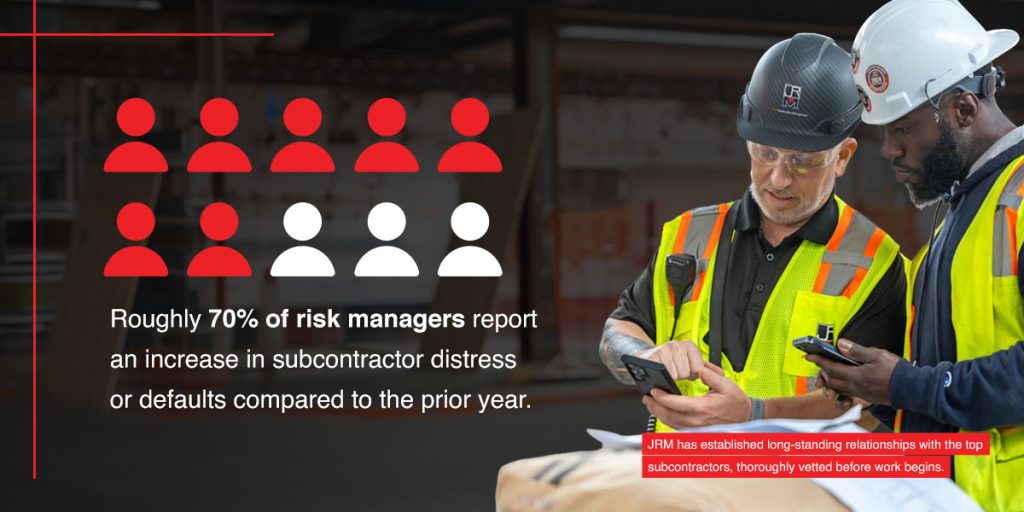
Roughly 70% of risk managers report an increase in subcontractor distress or defaults compared to the prior year. Strong firms with established general contracting capabilities maintain relationships with prequalified subcontractors and monitor their financial health throughout the project.
Preconstruction Capabilities
Preconstruction is the phase in which the most controllable project risks are addressed before construction begins. A contractor with strong preconstruction capabilities provides conceptual budgeting, phasing plans, value engineering, logistics planning and design feasibility review before a shovel hits the floor.
Are comprehensive preconstruction services built into the contractor’s process or treated as an afterthought? Preconstruction investment reduces downstream cost and schedule risk by identifying conflicts and refining scope before construction.
Schedule Management
Office build-outs are almost always time-sensitive. Leases expire, businesses need to be operational, and every week of delay is costly. How does the contractor build their project schedule? How do they track progress against it? How do they handle delays? A contractor without a structured scheduling methodology is guessing.
Construction projects frequently miss their original deadlines, which makes disciplined schedule management nonnegotiable. Strong construction management processes include milestone tracking, delay mitigation protocols and regular schedule updates.
Communication Protocols
Who will be the day-to-day point of contact? How often will you receive written updates? What’s the escalation path when issues arise? How are requests for information and submittals tracked? Poor communication is a leading cause of project failure in construction.
Establish communication and project visibility expectations up front. A contractor who cannot define their communication structure before the project starts will not improve once construction is underway.
Red Flags to Watch for When Hiring a General Contractor
The following warning signs indicate a contractor who may not meet the standards outlined in the above office build-out checklist:
- No commercial tenant improvement experience in portfolio: A contractor whose work history is primarily residential or ground-up commercial lacks the specific expertise required for office TI projects.
- Unwillingness to provide an itemized bid: Lump-sum bids without line-item detail make cost comparisons impossible and suggest the contractor is not prepared to defend their pricing.
- Vague or verbal-only change order process: If the contractor can’t articulate their change order process in writing, they’re unprepared to manage scope changes professionally.
- Inability to name key subcontractors or provide prequalification documentation: This suggests the contractor does not vet subs for financial stability or performance history.
- No preconstruction process offered: Skipping preconstruction planning or treating it as optional means forgoing the phase where most controllable risk is addressed.
- No structured scheduling methodology: A contractor who cannot explain how they build and track project schedules is unlikely to deliver on time.
- Unclear communication protocols: If the contractor can’t define who will communicate with you, how often and through what channels, they won’t improve once construction begins.
Start Your Office Build-Out With JRM Construction Management
A qualified general contractor should meet the criteria outlined above. JRM Construction Management was built around these principles. We produce realistic budgets grounded in historical data rather than aspirational projections.
Preconstruction planning, vetted subcontractor relationships and principal involvement at every project stage are embedded in JRM’s operations. Whether your project is in New York City (JRM’s headquarters), New Jersey (JRM New Jersey), California (JRM West) or Florida (JRM South), we bring the design to life with accountability at every phase.
Contact JRM to discuss your office build-out.
)